How to calculate your net worth (and what counts) in Australia
Add up what you own, subtract what you owe, and be honest about the awkward middle: super you can't touch yet, a HECS debt that grows by indexation, a property value that's really a guess, and a car that loses money while it sits in the driveway. We walk through what counts, at what value, and how to keep the number honest.
The short version
- Net worth is everything you own minus everything you owe. The formula takes a minute; the honesty takes longer.
- Super counts (it's yours, just locked until preservation age). HECS counts as a debt, and it's indexed each 1 June even though it charges no interest.
- Value property at what it would realistically sell for, cars at resale value, and skip the furniture. Consistency matters more than precision.
Most people can name their salary to the dollar and their net worth not even to the nearest hundred thousand. That's backwards.
Your salary describes one year. Your net worth describes every financial decision you've ever made, netted out, and it's the single number that tells you whether your finances are working.
In Australia the calculation comes with a few genuinely tricky judgement calls (super, HECS, the house) that generic American explainers skip entirely. So let's do it properly.
What is net worth, exactly?
Net worth is the total value of everything you own minus the total of everything you owe. Assets minus debts, one subtraction.
Assets include cash, savings, super, shares and ETFs, property, and anything else of real resale value. Debts include your mortgage, HECS-HELP balance, car loan, credit card balances and anything else with your name on it.
The result can be negative, especially early on. A negative number tells you where you're starting from, and nothing more than that.
The arithmetic is primary school stuff. This article is really about the judgement calls: which assets count, at what value, and how to treat the two most argued-about items on any Australian balance sheet, super and HECS.
Which assets count?
Count everything you could genuinely convert to money, at the value it would genuinely fetch. In practice that means:
- Cash and savings: every transaction, savings and term-deposit balance, plus money in an offset account (it's your cash, sitting next to a loan).
- Superannuation: your current balance across every fund. More on the caveat below.
- Investments: shares, ETFs, managed funds, bonds and crypto, at current market value.
- Property: your home and any investment property, at realistic market value, with the loans counted separately as debts.
- Vehicles: at what they'd sell for today, not what you paid.
- Money owed to you that you'll actually collect, like a bond you'll get back.
Leave out furniture, electronics, clothes and the rest of the household clutter. Their resale value is a fraction of what you paid, you're not going to sell them, and including them only blurs the number.
One exception is worth making. A genuine collectible with a market, like art or a vintage car, can go in at a conservative estimate if it's worth a material amount.
Is super part of your net worth?
Yes, super counts. It's money invested in your name, it compounds for your benefit, and for many Australians it becomes their second-largest asset after the house.
Leaving super out gives you a wrong number rather than a conservative one.
Access is the honest caveat. You generally can't touch super until preservation age, so a 30-year-old with $60,000 in super and $5,000 in the bank is wealthy on paper and skint at the ATM.
Track both readings. Use total net worth including super for the long game, and the accessible slice for decisions you're making this decade, like a house deposit.
Kleev's wealth view keeps super as its own line, so you can see both readings at once instead of one blended number.
Does HECS reduce your net worth?
Yes. A HECS-HELP balance is a debt, so it subtracts from your net worth like any other. It's also the strangest debt you'll ever hold, and the strangeness cuts both ways.
How much does HECS indexation add?
HECS charges no interest. The ATO does apply indexation on 1 June each year to any balance unpaid for more than 11 months, so the debt still grows in nominal terms.
Here is where the rates have landed:
- Since 2025 the indexation rate has been the lower of CPI and WPI.
- The ATO's published rates are 2.8% for 2026 and 3.2% for 2025.
- The spike years were retrospectively reduced: 2023's 7.1% was cut to 3.2%, and 2024's 4.7% to 4%.
- The government applied a one-off 20% reduction to every study loan balance that existed on 1 June 2025, which the ATO finished processing in 2026.
- From 2025-26, compulsory repayments only start once your repayment income passes $67,000, and they are calculated only on the income above that threshold.
So what does that mean for your balance sheet? Count the debt at its current ATO balance, but don't panic about it the way you would a car loan at 9%.
Because the rate is now capped at the lower of CPI and WPI, the debt can't grow faster than the wage index. It tends to shrink relative to your earning power even when the nominal number creeps up.
HECS reduces your net worth. It shouldn't dominate your decisions.

What value should you put on your property?
Use a realistic current market value, meaning what the place would actually sell for this month. Skip what you paid, the council valuation, and the most optimistic bank estimate you've ever seen.
Recent sales of genuinely comparable properties nearby are the best free evidence. If you're stuck between two honest guesses, pick the lower one, because a slightly understated net worth never hurt anyone while a flattering one distorts every decision built on it.
Then count the mortgage in full on the debts side. The gap between the two is your equity, and watching that gap move tells you far more than either number alone.
If the property might one day become a rental, the way you structure the loan against it matters enormously for tax. We've made that argument separately in our piece on offset accounts versus paying down the loan.
Should you count your car?
Yes, at resale value, and with clear eyes. A car loses value every year while often carrying a loan that shrinks more slowly.
Put the realistic sale price on the assets side and the remaining loan on the debts side, then update the car's value once or twice a year. If the result stings, the balance sheet is doing its job.

How do you compare with other Australians?
Compare carefully, and use the right figure. The most recent ABS Survey of Income and Housing (2019-20, released April 2022) put the median Australian household net worth at $579,200, while the mean was about $1.04 million.
The gap between those two numbers is the point. A small number of very wealthy households drags the average far above the middle, so compare yourself against the median.
Both figures are per household rather than per person, and they cover every age group. A 28-year-old comparing their solo balance sheet against a national household median is using the wrong measuring stick.
We've written more about age-based comparisons and their limits in how much you should have saved by 30.
How often should you update it?
Update it monthly. Yearly is too slow to change your behaviour, and daily is noise.
A monthly reading is frequent enough to show the trend and rare enough that market wobbles don't wreck your mood. Watch the direction over quarters and years rather than the level on any given day.
The tedious part was always the assembly: six logins, a property guess, a super portal, and a spreadsheet that dies every March.
Kleev builds the balance sheet from data you already have. Bank balances come from the CSVs you import, property comes from your property dashboard, and super, investments and debts like HECS are added by hand once and then updated.
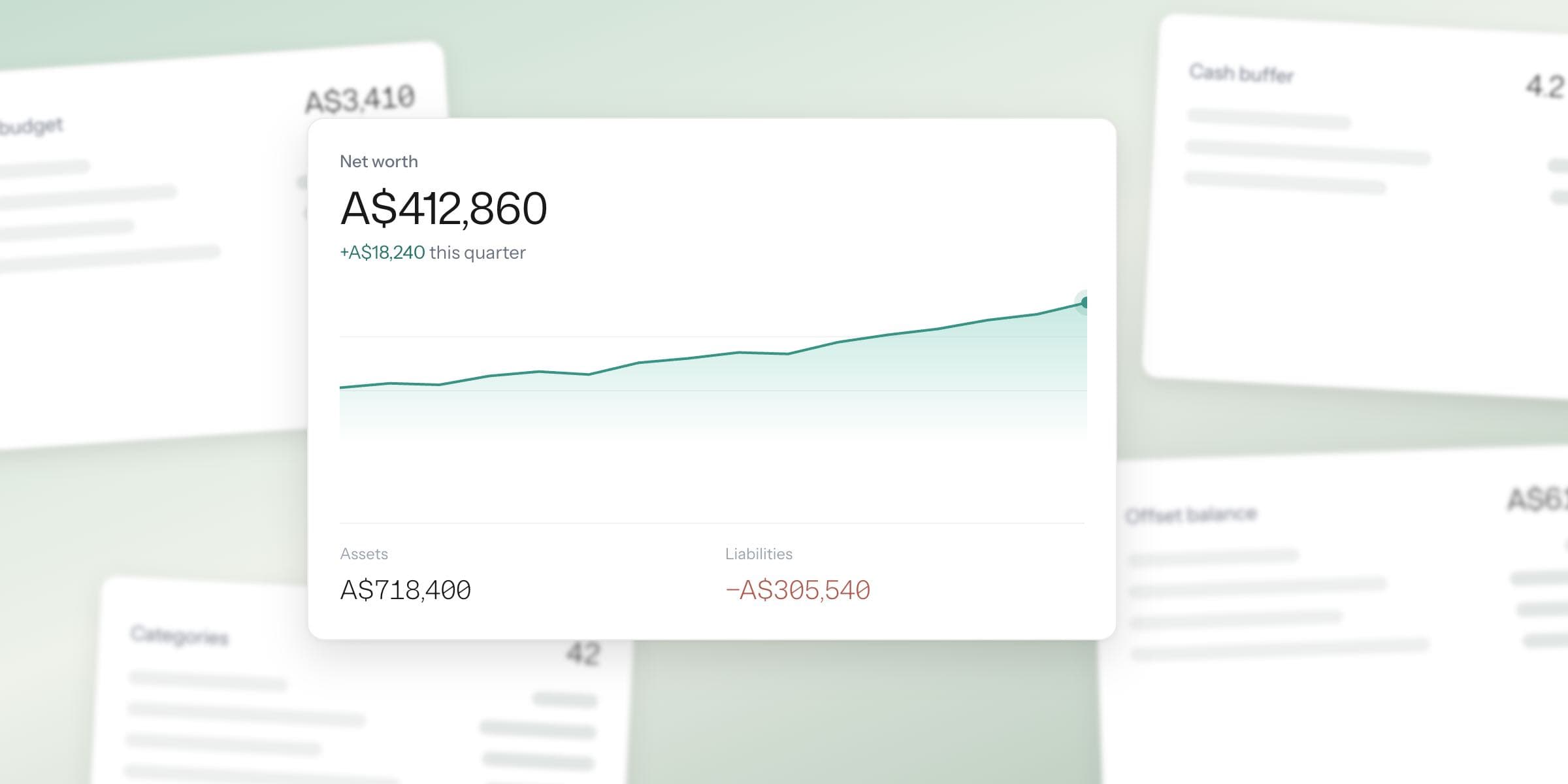
You get one page: assets minus debts, traced month by month. See your whole net worth in Kleev →
The fine print
- This article is general information, not financial advice. Kleev describes your own data and does not give financial advice.
- HECS indexation rates, repayment thresholds and the ABS figures cited are as published at the time of writing; check ato.gov.au and abs.gov.au for current numbers.
- For decisions with real money attached, talk to a licensed financial adviser.
Common questions
Does HECS reduce my net worth?
Yes. A HECS-HELP balance is money you owe, so it belongs on the debts side of your net worth. It has no interest rate, but the ATO indexes the unpaid balance every 1 June, by 2.8% in 2026, using the lower of CPI and WPI, so the debt still grows if you aren't repaying it. Count it, then remember that repayments only kick in once your income passes the repayment threshold ($67,000 from 2025-26).
Is super part of my net worth?
Yes. Your superannuation balance is an asset you own, invested in your name, so it counts in your net worth. The caveat is access: you generally can't touch it until preservation age, so many people track it as part of total net worth while watching a separate figure for the wealth they can actually use before retirement.
Should I include the family home in my net worth?
Yes, at a realistic market value, with the mortgage counted on the debts side. Your home is usually the largest single item on the sheet, so leaving it out understates your position badly. If you want a number that reflects wealth you could deploy without selling the house, track an investable net worth alongside the full one.
Is my car an asset for net worth purposes?
Yes, but at what it would actually sell for today, not what you paid. Cars lose value every year, so a car-heavy balance sheet flatters you less over time. Most people include cars at a rough resale value, update it once or twice a year, and leave smaller possessions like furniture and electronics out entirely.
What is the median net worth in Australia?
The most recent ABS Survey of Income and Housing (2019-20, released April 2022) put median Australian household net worth at $579,200, with the mean much higher at about $1.04 million because large fortunes pull the average up. Both figures are per household, not per person, so don't compare your individual balance sheet against them directly.